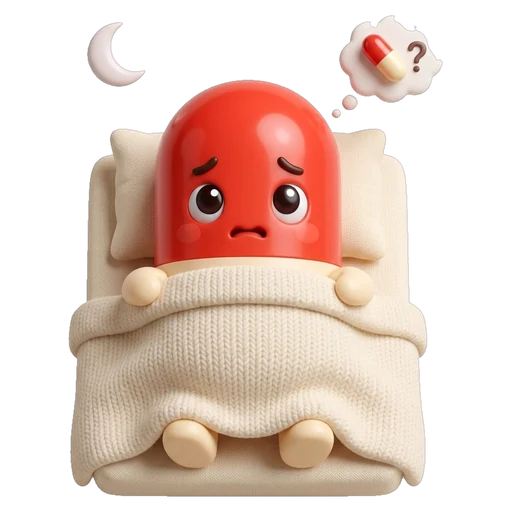
Why can't you remember whether you took your pill?
Remembering whether you already did something has a name in psychology, output monitoring, and it is unreliable for everyone: when it fails, people repeat an action or leave it out (Skladzien, 2010). In lab studies, people often reported having carried out an intended action when they had not, and making the action more distinctive at the time reduced that error (Marsh et al., 2002).
A pill swallowed on autopilot is about as undistinctive as an action gets. The five-hundredth identical morning blurs into "a morning", which is efficient right up until you need to know whether this specific morning included the pill. That is why the doubt feels so convincing: there is very little to find.
Never resolve it by guessing
Taking a second dose "just in case" or skipping "just in case" are both bets. Whether either is safe depends entirely on the medication, which is a question for your pharmacist, not for a website. The only thing that removes the bet is a record.
What kind of dose record do people actually keep?
PillPal turns the dose into a recorded act: tapping Taken on the notification writes the dose with its time, the Today screen shows it with a green check and the widget drops the count. That matters because people keep the logs that cost nothing. A paper chart is easy to abandon; a one-tap log on the lock screen, at the moment the reminder fires, lasts because it is faster than ignoring the reminder.
A weekly pill organiser is the physical version of the same record: an open compartment means the dose came out. In an observational study of 245 people on HIV treatment, using a pillbox organiser was estimated to improve adherence by about 4% (Petersen et al., 2007). The organiser and the app answer different questions, so the strong setup uses both.
How do you check in one second?
The check has to be faster than the doubt. On iPhone, PillPal's home-screen widget shows "0 doses left" when the day is done, which ends the loop before it starts. If you are already in bed, the Today screen shows every dose of the day with its status, and the history shows yesterday if the doubt is about that.
The check matters more with age. Across two experiments, older adults monitored their past actions less accurately than younger adults, and their errors were mostly repetitions (Skladzien, 2010), which in real life is the double dose a record prevents. What a pill reminder for seniors needs.
How do you prevent a double dose?
Two habits close the last gap. First, log at the moment of swallowing, not "in a minute". Second, when a reminder for a dose you already took appears (because you took it early), tap Taken rather than dismissing it, so the record matches reality.
PillPal is a reminder tool, not medical advice. Nothing here tells you what to take or how much; follow your doctor's or pharmacist's instructions.
Sources
- Skladzien EM. Age differences in output-monitoring accuracy. Aging, Neuropsychology, and Cognition, 2010;17(2):240-256.
- Marsh RL, Hicks JL, Hancock TW, Munsayac K. Investigating the output monitoring component of event-based prospective memory performance. Memory and Cognition, 2002;30(2):302-311.
- Petersen ML, Wang Y, van der Laan MJ, Guzman D, Riley E, Bangsberg DR. Pillbox organizers are associated with improved adherence to HIV antiretroviral therapy and viral suppression: a marginal structural model analysis. Clinical Infectious Diseases, 2007;45(7):908-915.
Quick answers
What should I do if I cannot remember whether I took my medication?
Check a record if you have one. If you do not, ask a pharmacist what is safe for that specific medication before deciding; the right answer differs by drug.
Does PillPal show the time I took a dose?
Yes. Each dose is stored with the time it was scheduled for and marked with a green check on the Today screen once you tap Taken. The dose history keeps taken and skipped doses for about 13 months, so you can look back at last week or last month, and you can undo an entry if you tapped the wrong button.
Try it on tomorrow's first dose
Add what you take, pick a time, and let PillPal do the remembering. Free to start, no account, works offline.